22nd IAHR-APD Congress in Sapporo, Japan

22nd IAHR-APD Congress
"Creating Resilience to Water-Related Challenges"
Sapporo, Japan, September 14-17, 2020
Welcome Messages
Dear Colleague,
We are honored to invite you to the 22nd Congress of the International Association for Hydro-Environment Engineering and Research -Asia and Pacific Division (IAHR-APD). The congress will be held in Sapporo from September 14 to 17, 2020.
The theme of the congress is “Creating resilience to water-related challenges”. Due to global climate change, disasters induced by extreme weather have been increasing, and Japan has not escaped such disasters. Extraordinary heavy rains have been causing large-scale disasters every year. These occurred at the Kinu River in 2015, in Central Hokkaido in 2016, in Northern Kyushu in 2017, and in Western Honshu in 2018. The disasters caused tremendous damage and loss from flooding and landslides.
To overcome climate change-induced disasters and to create infrastructure that mitigates the damage and loss caused by such disasters, hydro-environmental engineers are expected to identify the factors involved in such disasters and to propose countermeasures. We encourage all who are involved in hydro-environmental engineering to contribute to the congress, which will be an important opportunity for researchers and other participants from the Asia-Pacific region to share experience and knowledge.
We will strive to make the 22nd congress a pivotal event in addressing climate change. It will be hosted by Hokkaido University, the Japan Society of Civil Engineers and many organizations in Japan.
Sapporo, the capital of Hokkaido, is the fifth-most-populous city in Japan. It is famous for its annual snow festival, and autumn is another excellent time to visit. It is the most delicious season in Sapporo, with salmon returning to spawn, fruits ripening in the orchards and various harvest festivals taking place. The fall foliage is spectacular.
We look forward to receiving a research abstract from you and seeing you in Sapporo in September 2020.
Sincerely,
Prof. Yasuyuki Shimizu
Chairman of the Local Organizing Committee
The 22nd Congress of IAHR-APD
The 22nd IAHR APD Congress with its theme “Creating resilience to water-related challenges” cannot be timelier in these times of urgent need for adequate coordinated policy to mitigate climate change impacts through weather related disasters. These policies need to be well informed by innovative research and engineering knowledge.
The 22nd IAHR APD Congress is expected to bring together Engineers, Scientist, Academics and Policymakers, round the world and particularly from the Asia Pacific Region for in depth discussion and contribution to the global knowledge base in Hydro Environmental Engineering and Management area. In addition, the special session on Historic Water Projects and Traditional Water Technologies is expected to inform past practices and its future uses.
Japan a uniquely beautiful country together with its traditional Japanese hospitality is certain to further enhance the Congress experience.
On behalf of the IAHR APD, I look forward to your participation at the Congress.
Dr. Gregory Shahane De Costa
President – IAHR APD
Program
Overall program:

Opening Ceremony
2020/9/15, 10:00 am, Opening ceremony starts
MC: Prof. Norihiro IZUMI, Hokkaido University
Greeting from Prof. Yasuyuki Shimizu, Chair of APD 2020 LOC
Greeting from Prof. Joseph Hun-wei Lee, IAHR President
Greeting from Prof. Gregory De Costa, Chair of IAHR-APD
IAHR Hydro-Environment Asia and Pacific Division Heritage Award
Award for Sayamaike Reservoir: This facility has been developed in the ancient period for providing an irrigation water to the Osaka Plain using channel network and reservoir cascade system and been reinforced and heightened repeatedly to increase the reservoir capacity with the expansion of the irrigation area and is still being utilized in the area. Osaka-Sayama City, Japan and Osaka Pref., Japan
Award for Tatsumi Aqueduct: This facility has been developed in the early modern period for supplying water as fire protection, drinking water, pouring water into a moat, and water for agriculture using tunnel and inverted siphon technology and is still being utilized in the area. Tatsumi Aqueduct Land Improvement District, Japan, Kanazawa City, Japan and Ishikawa Pref., Japan
Award for Flood controls and water utilization facilities in the Ishikari River basin: This facility has been developed in the late modern period for transforming cold region peatlands into rice cultivation areas, leading to the formation of a major economic zone and is still being utilized in the area. Hokkaido Regional Development Bureau, Ministry of Land, Infrastructure, Transport and Tourism, Japan and Hokkaido Government, Japan
Keynote Speakers
Prof. M. Levent Kavvas: Professor, UC Davis
Dr. Jonathan Nelson: USGS Geomorphology and Sediment Transport Laboratory
Prof. Tetsuya SUMI: Professor, Water Resources Research Center, Disaster Prevention Research Institute, Kyoto University
Prof. Il Won SEO: Professor, Civil and Environmental Engineering, Seoul National University
Prof. Xudong Fu: Professor, Tsinghua University
Prof. CHANG Tsang-Jung: Professor, Dept. of Bioenvironmental Systems Engineering; Professor, Hydrotech Research Institute; Professor, Center of Climate Change and Sustainable Development, Taiwan University

Short Course
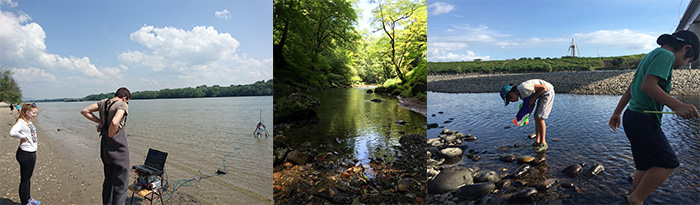
On-line virtual course on stream gauging
Here, a virtual course means that the course is composed of the materials used in RiverFlow 2018 and reconfigured for the online virtual course by Ryota Tsubaki@Nagoya University.
Introduction
Introduction to the course and overview of hydrometry by Jérôme LE COZ
Fundamentals
Stream gauging techniques: velocity-area, ADCP, dilution, volumetric… by Alexandre HAUET
Principles of surface velocity gaugings (floats, video, radar) by FUJITA Ichiro
Indirect determination of peak discharge (slope-area and image processing) by Jérôme LE COZ
Selection of gauging station sites by Tommaso ABRATE
Measurement of discharge by precalibrated measuring structure and miscellaneous methods by Roberto RANZI
Non-intrusive velocimetry techniques using image processing by FUJITA Ichiro
Rating curves
Discharge rating using the index velocity method by Jérôme LE COZ
Stage-discharge rating curves: I. Methods by Roberto RANZI
Stage-discharge rating curves: II. Issues (hysteresis, Variable slope, Rating shifts) by Marian MUSTE
Uncertainty in stream gauging
Uncertainty of discharge measurement: The Hydrometric Uncertainty Guidance (HUG) and uncertainty of discharge measurement by conventional current meter methods by Roberto RANZI
Uncertainty analysis of ADCP gaugings: computations (GUM) by Marian MUSTE
Uncertainty analysis of ADCP gaugings: empirical assessment (interlaboratory experiments) by Jérôme LE COZ
Uncertainty analysis of rating curves, streamflow records and hydrological indicators by Jérôme LE COZ
Committees
Local Organizing Committee
Local Scientific Committee (Editor team)
International Science Committee
IAHR-APD Executive Committee
Sponsors
Supported by
River Center of Hokkaido
Civil Engineering Research Institute for Cold Region
Hokkaido Regional Development Bureau
Hokkaido Prefecture
Sapporo city, Hokkaido
Faculty of Engineering, Hokkaido University
Exhibition booth
We regret inform you that exhibition booth at the venue is canceled.
Online Technical Tours
Tokachi River (huge experimental flume and fishways)
Ishikari River-mouth bridge near the estuary, Hokkaido, Japan: Downstream of the Ishikari River with a width of 1500m. The sluice gate of the confluent (Makunbetsu) river plays an important role to prevent backflow water in the low-gradient city area.
Chiruwatsunai River, Kushiro Marsh, Hokkaido Japan: Beautiful Chiruwatsunai River meandering in Kushiro wetland, Hokkaido. The river is mostly spring water fed, has a gentle slope and an undisturbed topography for a long time.
Amazing Tidal creek, Yausyubetsu River, Notsuke Peninsula, Hokkaido, Japan: Amazing tidal creek created by the tide of brackish Furen lake. It can be seen at the most eastern part of Hokkaido.
Tidal Creeks, Syunkuni lagoon created by sandbars between the ocean and Furen Lake, Hokkaido, Japan: Shunkokutai is a tidal wetland created by sandbars. Given the diverse natural surroundings, this wetland is also called a “miracle island”.
Toyohira River near the Sapporo City, Hokkaido, Japan: The Toyohira River having a steep gradient that flows through the center of Sapporo city. When it rains heavily, the river flows very fast.
Deep waterfall of the Toyohira River, bedrock exposure, Hokkaido Japan: An exposed area of bedrocks, located upstream of the Toyohira River. The waterfall is gradually moving upstream.
Bibi River near the Chitose Airport, Hokkaido Japan: Bibi River is a relative small river but bery beautiful wetland contains lots of sprig water near the Chitose Airport.
Bisei River damaged by 2016 record-braeking rainfall, Hokkaido, Japan: Confluence between the Tokachi and Bisei Rivers. This video was taken after one year had been passed from the 2016 record-breaking rainfall.
Otofuke River damaged by 2016 record-braeking rainfall, Hokkaido, Japan: Otofuke River, a tributary of the Tokachi River, damaged by 2016 record-breaking rainfall.
Gully terrain seen in Wakkanai area: A mountainous area where no trees grow due to the strong wind. You can see beautiful gully terrain.